

Why Ecommerce Website Hosting Matters for Your Online Store's Success
Ecommerce website hosting is the specialized infrastructure that powers your online store. Unlike standard web hosting, it's built to handle the unique demands of selling online, from high traffic during sales to secure payment processing. The right host handles the technical side so you can focus on growth, while the wrong one leads to lost sales and frustrated customers.
Quick Answer: What Makes Ecommerce Hosting Different?
- Improved Security: Built-in SSL certificates, PCI compliance, and cyber attack protection to safeguard customer data.
- Higher Performance: Optimized servers with SSD/NVMe storage and CDN integration to handle large product catalogs.
- Scalability: Automatic resource allocation to manage traffic surges without downtime.
- Specialized Support: 24/7 expert assistance for shopping carts, payment gateways, and platform-specific issues.
- Reliability: 99.9%+ uptime guarantees, because every second offline costs you sales.
As experts in the ecommerce space, we've worked with hundreds of entrepreneurs and have seen firsthand how choosing the right hosting foundation is the first critical decision every store owner makes. This guide will help you get it right.
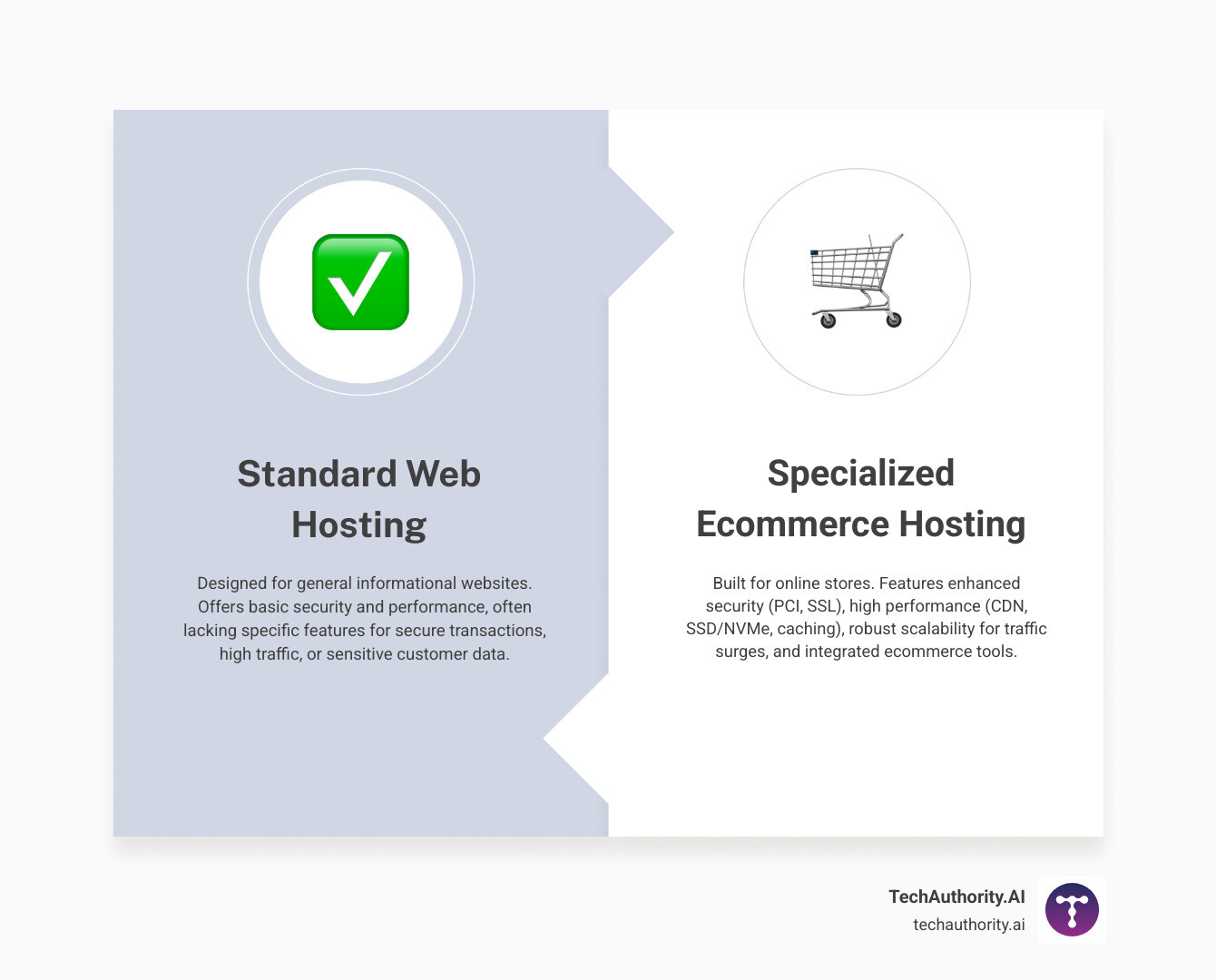
Ecommerce website hosting terminology:
What is Ecommerce Hosting and Why It's Not Your Standard Web Hosting
Ecommerce website hosting is the digital foundation where your online store operates—every product image, shopping cart, and transaction lives here. While you could use standard web hosting, it's like trying to run a busy department store out of a small studio apartment. It’s just not equipped for the job.
Standard hosting is fine for simple blogs or portfolio sites with static content. An online store, however, is a different animal. It's constantly working, managing inventory, processing orders, and handling sensitive payment information in real-time. This requires serious computing power, storage for high-resolution media, and bandwidth for hundreds of simultaneous visitors.
Furthermore, the security needs are non-negotiable. You are legally and ethically required to protect customer credit card details and personal data. A single breach can destroy customer trust and your business. Specialized ecommerce hosting is built from the ground up to handle these exact challenges, integrating shopping cart functionality and payment gateways securely. Our Hosting Services are designed with these unique demands in mind.
Key Differentiators of specialized ecommerce website hosting
Specialized ecommerce website hosting provides features that directly impact your sales:
- Improved security: Essential protections like SSL certificates, advanced firewalls, and PCI compliance (the mandatory standard for handling credit card data) are built-in to protect your business and customers.
- High-traffic capacity: Specialized hosting anticipates traffic surges from sales or holidays, often using auto-scaling to allocate more resources automatically and prevent your site from crashing.
- Performance optimization: Using faster SSD/NVMe storage, Content Delivery Networks (CDNs), and advanced caching, these hosts deliver a snappy browsing experience that keeps customers engaged.
- Database support: Optimized databases ensure your product catalogs, inventory, and customer accounts are managed efficiently, even as your store grows.
Understanding these differentiators is key to setting your store up for success. For a deeper dive, see our Ecommerce Development Solution Ultimate Guide.
The Non-Negotiables: 7 Key Features for Top-Tier Ecommerce Hosting
When shopping for ecommerce website hosting, it's easy to get lost in technical jargon. To succeed, you must get the fundamentals right. Cutting corners on hosting leads to lost sales, security breaches, and frustrated customers.
So what separates exceptional ecommerce hosting from mediocre options? I've narrowed it down to seven non-negotiables—the features that truly matter when real money is on the line. These are the pillars that support your store from its first sale to thousands of daily transactions.
- Uptime keeps your store open for business.
- Speed prevents customers from abandoning their carts.
- Security protects your business and customer data.
- Support ensures you have help when you need it.
- Scalability lets your business grow without technical problems.
- Pricing transparency avoids surprise bills.
- Integrations ensure your platform works seamlessly with your host.
Miss even one, and you're building your business on an incomplete foundation. For more on making the right choice, check out our guide on How to Choose Hosting. We'll now dive into each of these essentials so you know exactly what to look for.
1. Ironclad Security (PCI Compliance & SSL)
Security isn't just a feature; it's a promise to your customers. For an ecommerce store, anything less than ironclad security is a gamble you can't afford to take.

PCI compliance is the mandatory security standard for any business that processes credit card information. Quality ecommerce website hosting providers build their infrastructure to meet these requirements, which you can learn more about at the PCI Security Standards Council. Without it, you risk fines and put customer data in jeopardy.
SSL certificates are your first line of defense, encrypting the connection between a customer's browser and your site. Without that padlock icon, browsers will flag your site as “Not Secure,” killing trust instantly. Most reputable hosts include free SSL certificates.
Beyond these basics, look for a host that provides:
- Data encryption to protect stored information.
- Malware scanning and removal to proactively find and neutralize threats. Our WordPress Hosting with Malware Scanning offers this automatically.
- DDoS protection to keep your site online during malicious traffic floods.
- A Web Application Firewall (WAF) to filter out malicious requests.
- Automatic backups as a safety net to restore your site quickly if the worst happens.
Customers trust you with their sensitive data. A secure host protects that trust, which is the cornerstone of any successful online business.
2. Blazing-Fast Speed and Performance
In ecommerce, speed is money. Every second your page takes to load increases the chance a customer will leave. Google data on speed impact shows that as load time goes from one to five seconds, the probability of a visitor bouncing jumps by 90%. Slow speeds lead directly to abandoned carts and lost sales.
Top-tier ecommerce website hosting is built for performance with a technology stack that makes your store fast by default:
- Content Delivery Networks (CDNs): A CDN stores copies of your content in servers around the world, delivering it from the location nearest to your customer. This dramatically reduces load times for a global audience.
- SSD/NVMe Storage: Modern Solid-State Drives (SSD) and NVMe storage access data far faster than traditional hard drives, making your product images and pages load in milliseconds.
- Caching: This feature stores ready-to-serve versions of your pages, so the server doesn't have to rebuild them for every visitor. This reduces server load and delivers content faster.
Optimized server configurations also ensure that database queries and scripts run efficiently behind the scenes. As a bonus, Google rewards fast websites with better search rankings, boosting your visibility. If you're on WordPress, our guide to Improve WordPress Loading Speed offers more specific tactics.
3. Guaranteed High Uptime
Imagine a customer is ready to buy at 2 AM, but your site is down. You've not only lost a sale but likely that customer forever. This is why uptime—the percentage of time your website is accessible—is critical for ecommerce website hosting.
Anything less than a 99.9% uptime guarantee should be a deal-breaker. Even 99% uptime means your store could be offline for over three days a year. That's three days of zero sales and damage to your brand's reputation. Every minute of downtime costs you money and customer trust.

What delivers 99.9%+ uptime? It comes down to robust infrastructure with redundant power and network connections, so if one system fails, another takes over instantly. The best hosts also use proactive monitoring to catch and fix issues before they affect your site.
Your online store must be open 24/7. Reliable uptime isn't a luxury; it's the foundation of your business. Look for transparent uptime guarantees from any provider you consider.
4. Effortless Scalability for Growth
What happens when your marketing campaign goes viral and thousands of shoppers flood your site? If your hosting can't handle the surge, your dream scenario becomes a nightmare of crashed pages and lost sales.
This is where scalability is critical. Scalable ecommerce website hosting means your infrastructure grows with you, automatically adjusting resources to handle traffic spikes. Think of it as an elastic storefront that expands during busy times like Black Friday and shrinks during quiet periods, so you're not paying for power you don't need.
The key resources that need to scale are CPU (processing power), RAM (memory), and bandwidth. As your product catalog and traffic grow, so do your resource needs.
Different hosting types offer different levels of scalability:
- VPS hosting provides a dedicated slice of server resources, perfect for stores outgrowing shared hosting.
- Cloud hosting offers the most flexibility, drawing from a network of servers to scale resources up or down automatically based on real-time demand.
- Dedicated servers give you an entire physical server for maximum power and control.
Choosing a scalable host from the start prevents painful migrations later. Our Best Managed Hosting Providers guide explores solutions designed to grow with your business, ensuring your biggest sales day is a success, not a technical disaster.
5. 24/7 Expert Customer Support
It's 2 AM, and your site is down. Every minute offline means lost revenue. This is when 24/7 expert customer support becomes an absolute lifeline for your business.
For ecommerce website hosting, support isn't just about fixing problems—it's about protecting your income. The best support teams are not only available around the clock but also have deep expertise in ecommerce platforms like WooCommerce or Magento. They can diagnose issues quickly because they understand the specific challenges of running an online store.
Look for a host that offers multiple support channels:
- Live chat and phone support provide immediate help for urgent issues.
- Email and ticketing systems are great for less urgent, complex problems that require detailed investigation.
- A comprehensive knowledge base with tutorials and FAQs empowers you to solve minor issues on your own, saving you time.
Managed support takes this a step further. With managed hosting, a team of experts proactively monitors your site, handles security patches, performs updates, and optimizes performance behind the scenes. They act as an extension of your technical team, preventing problems before they start.
Technical challenges are inevitable. Having genuine experts in your corner who can fix things fast is the difference between a minor hiccup and a full-blown crisis.
6. Transparent Pricing & Value
When choosing ecommerce website hosting, understanding the true cost is crucial. The cheapest option is rarely the best value, and hidden fees can quickly erase initial savings.
Here’s what to watch out for:
-
Introductory vs. Renewal Rates: Many hosts advertise a low introductory price that doubles or triples upon renewal. Always check the long-term cost, as that's what you'll actually be paying.
-
Hidden Costs: A cheap plan might not include essentials like SSL certificates, daily backups, or a CDN. A slightly more expensive, all-inclusive plan is often more affordable in the long run.
-
Resource Limits: Be wary of “unlimited” bandwidth or storage claims. Read the fine print for usage thresholds that could lead to overage fees or a throttled site speed just when your store gets busy.
Value is more important than price. Paying a few dollars more per month for a host that guarantees uptime, speed, and expert support will save you hundreds or thousands in lost sales. For a comprehensive look at what to budget, check out our Ecommerce Web Design Pricing Guide.
7. Seamless Ecommerce Platform Integration
Your ecommerce platform and your hosting should work together in perfect harmony. Whether you're using WooCommerce, Magento, or another platform, the right ecommerce website hosting environment makes the difference between a smooth operation and constant technical headaches.
Look for hosting that is specifically optimized for your chosen platform. Key features include:
-
One-Click Installers: These tools get your store's software (like WordPress with WooCommerce) installed and running in minutes, without requiring you to manually configure databases or use FTP.
-
Managed Application Hosting: This is a game-changer. It means the host has tuned the entire server environment—including caching, security protocols, and PHP versions—for your specific platform's needs, ensuring maximum performance and stability.
-
Developer Tools: For those who need more control, features like SSH access, Git integration, and WP-CLI streamline development workflows and make custom work easier.
When your hosting and platform are aligned, you get faster page loads and fewer technical issues, freeing you up to focus on growth. Strong integration is also vital for technical SEO; our Woo Commerce SEO guide shows how a fast, reliable foundation is crucial for ranking well.
The Self-Hosted Advantage: Full Control Over Your Store
When building your online store, a key decision is choosing a platform that gives you the right balance of control, flexibility, and scalability. A self-hosted solution, such as WordPress with the WooCommerce plugin, offers unparalleled freedom to create a unique brand experience.
With a self-hosted solution, you choose your own ecommerce website hosting provider and have full control over every aspect of your store. This model offers unrivaled customization and flexibility, allowing you to build unique features and integrate with any third-party service. You own your data, and it's often more cost-effective in the long run.
While this approach means you are responsible for maintenance and security, this is where a quality managed hosting provider becomes essential. A service like our Managed WordPress Cloud Hosting handles the technical heavy lifting—like security, updates, and performance optimization—while you retain full creative control. This gives you the best of both worlds: the power of a custom-built store without the day-to-day technical management. This path is ideal for businesses with custom needs or those planning for significant growth and a unique brand experience, as detailed in our WooCommerce Conversion Rate Optimization guide.
To explore different platforms that can be self-hosted, see our guide on Ecommerce Development Platforms.
The Best Ecommerce Website Hosting for Your Business Stage
There is no single “best” ecommerce website hosting provider. The right choice depends on your business stage, budget, technical expertise, and growth plans. What works for a startup is different from what an enterprise needs.
Your goal is to match your hosting to your current needs while planning for the future. For comprehensive guidance, our Ecommerce Web Design and Development resources can help.
For Beginners & Startups: What to Look For
When you're starting out, your focus should be on simplicity and reliability. Look for:
- Affordability: Choose a plan with clear, predictable pricing that fits a startup budget.
- Ease of Setup: One-click installers and intuitive dashboards are essential for a quick launch.
- Bundled Features: A good starter plan includes free SSL, automated backups, and email accounts.
- Strong Support: 24/7 access to knowledgeable support via live chat or phone is a crucial safety net.
- Managed Hosting: Consider a service like Cheap Managed WordPress Hosting to offload technical tasks like updates and security.
For Scaling Businesses & Enterprises: Key Requirements
As your business grows, your hosting becomes a competitive advantage. You need power, performance, and control. Prioritize:
- Dedicated Resources: Move to VPS, cloud, or dedicated servers to guarantee CPU, RAM, and storage for your site.
- High Performance: Invest in NVMe storage and a robust CDN to ensure fast load times that support high transaction volumes.
- Advanced Security: Implement DDoS protection, a Web Application Firewall (WAF), and regular security audits.
- Seamless Scalability: Use cloud solutions that automatically scale resources to handle traffic spikes without manual intervention. See our Best Managed Hosting Providers for options.
- Developer Tools: Staging environments, SSH access, and Git integration are vital for custom development and efficient workflows, as offered by solutions like Managed WordPress Hosting for Agencies.
Frequently Asked Questions about Ecommerce Hosting
Choosing the right ecommerce website hosting brings up many questions. Here are answers to some of the most common ones we hear.
How much does ecommerce hosting typically cost?
The cost varies widely, from $10-$15 per month for basic shared plans to several hundred for dedicated servers. Key factors include the hosting type (shared, VPS, cloud), the resources included (storage, bandwidth), and the plan tier. Be cautious of low introductory pricing that skyrockets at renewal. A slightly more expensive plan that includes essentials like a free SSL certificate, CDN, and daily backups often provides better long-term value than a bare-bones option with hidden fees.
What is the main difference between web hosting and ecommerce hosting?
The main difference is specialization. Standard web hosting is for simpler, informational sites. Ecommerce hosting is specifically engineered for the demands of an online store. This means it includes much higher security requirements like PCI compliance to protect payment data, superior performance to handle large product databases and high-resolution images, and greater resource allocation (CPU, RAM) to ensure your site stays fast and stable during traffic surges and transactions. Not all web hosting is suitable for ecommerce.
Do I need special hosting for a WooCommerce store?
Yes, absolutely. While WooCommerce can technically run on any host that supports WordPress, it is a resource-intensive application. On standard hosting, a WooCommerce store will likely be slow, which directly hurts conversions. According to Google data on speed impact, every second counts.
Specialized hosting, particularly managed WordPress hosting, is optimized for WooCommerce's specific PHP and MySQL requirements. These hosts provide server-level caching, robust security, and automatic updates designed to make your store fast and secure. Our Managed WordPress Hosting Guide 2025 explores solutions that handle this technical optimization for you. This allows your store to perform at its best, providing a better customer experience and driving more revenue. For more tips, see our guide to Improve WordPress Loading Speed.
Conclusion: Making the Right Choice for Your Store
Choosing the right ecommerce website hosting is the foundation upon which your entire online business is built. Your marketing, product design, and customer service all depend on an infrastructure that works reliably when customers arrive ready to buy.
We've covered the non-negotiables: ironclad security, blazing-fast speed, guaranteed uptime, effortless scalability, and expert support. These aren't just features; they are the pillars that separate thriving stores from struggling ones.
Your hosting choice must align with your business stage and future goals. Whether you're a startup needing simplicity or a scaling enterprise needing power, the right host acts as a partner invested in your success. They handle the technical complexities so you can focus on what you do best: growing your business.
At TechAuthority.AI, we understand that your hosting provider should be a partner, not just a vendor. Invest wisely in your store's foundation, and you'll build a remarkable business that flourishes for years to come.
Ready to build or optimize your online store? Explore our WordPress Web Development Tools and let's get started.