

Why Your Online Store Needs Professional Management
Ecommerce website management services are specialized solutions that handle the technical operations, maintenance, and growth of your online store. These services typically include:
- Technical Maintenance: 24/7 monitoring, security updates, platform upgrades, and bug fixes
- Performance Optimization: Speed improvements, Core Web Vitals tuning, and server optimization
- Security Management: Proactive threat detection, vulnerability scanning, and compliance assurance
- Growth Services: Custom development, CRO testing, design improvements, and feature implementation
- Data Operations: Third-party integrations, API management, catalog updates, and analytics
Running an ecommerce store means juggling dozens of technical tasks every week. You're troubleshooting checkout errors at midnight. You're watching your site slow to a crawl during a flash sale. You're trying to figure out why your payment gateway stopped working.
Meanwhile, your actual business—sourcing products, building relationships, creating marketing campaigns—gets pushed to the side.
The research shows real results from outsourcing these headaches. One ice cream brand saw revenue jump 47% after bringing in managed services. The US Open Shop increased their conversion rate by 36%. These aren't flukes. They're what happens when experts handle the technical complexity while you focus on growth.
Most managed service providers offer tiered support levels. Entry packages start around $1,995/month and include regular audits, security monitoring, and basic development work. Premium services add dedicated project managers, advanced integrations with systems like ERPs and CRMs, and unlimited support hours.
The best providers don't just fix problems. They prevent them. They're scanning for vulnerabilities before hackers find them. They're optimizing your checkout flow based on real user behavior. They're implementing the latest platform updates without breaking your custom code.
At TechAuthority.AI, we provide expert guidance for entrepreneurs looking to optimize their digital presence. Through our extensive research into ecommerce website management services for clients ranging from mom-and-pop shops to established brands, we've seen how the right technical partner transforms struggling stores into revenue machines.
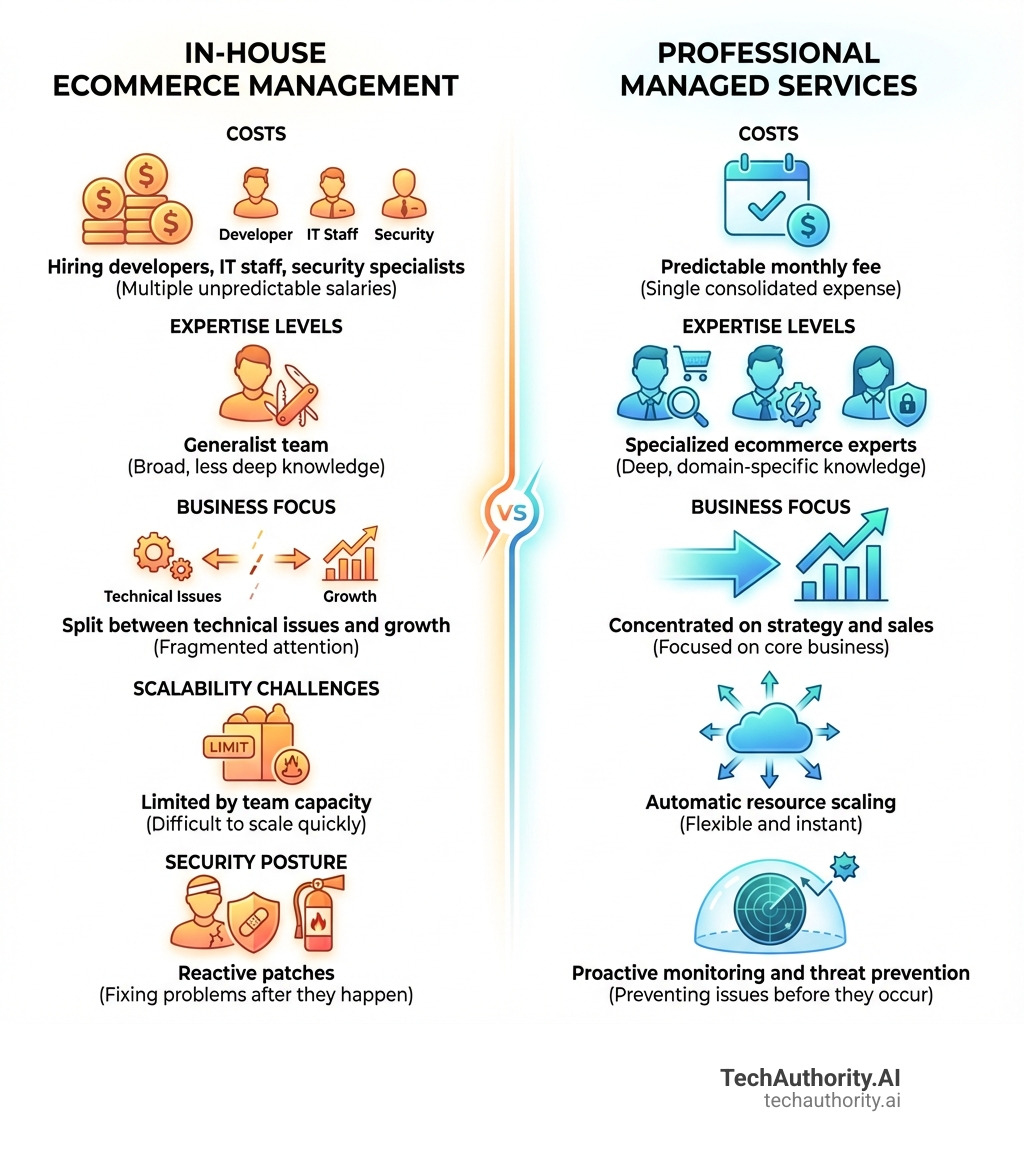
Ecommerce website management services terms made easy:
The Core Benefits: Why Outsource Your Ecommerce Management?
Running an online store is a full-time job, and then some. Between managing inventory, marketing, customer service, and everything else, the technical upkeep of your website can quickly become overwhelming. This is where ecommerce website management services shine, offering a lifeline to businesses looking to thrive online without getting bogged down in the minutiae.
Think of it this way: would you rather spend your precious time debugging a broken plugin or strategizing your next big product launch? Exactly! Outsourcing your ecommerce management allows us to focus on our core competencies – growing our business – while experts handle the technical heavy lifting.
One of the most compelling advantages is cost efficiency. Maintaining an in-house IT team for a complex ecommerce operation can be incredibly expensive. With managed services, we reduce operational overheads significantly. Instead of salaries, benefits, and training for multiple specialists, we get a predictable monthly fee for a team of experts. This isn't just about saving money; it's about smart allocation of resources.
Then there's the invaluable access to expert teams. Our research shows providers with “15+ years of experience in e-commerce” and “125K+ businesses trust our experience.” These aren't junior developers; these are seasoned professionals who live and breathe ecommerce. They bring a depth of knowledge that would be impossible or prohibitively expensive to build internally. They've seen it all, from obscure platform bugs to massive traffic spikes, and they know how to handle it. This expertise translates directly into improved website performance. For instance, after speed optimization, some large-scale ecommerce sites saw an average desktop score of 85 and a mobile score of 70, with an average time to first byte (TTFB) loading of just 1 second. Imagine the impact on user experience and SEO!
Advanced security protocols are another non-negotiable benefit. In today's digital landscape, a security breach can be catastrophic for an ecommerce business. Managed service providers offer continuous monitoring, threat detection, regular security audits, and compliance assurance (like ADA and GDPR). They proactively identify and address vulnerabilities, keeping our customer data safe and our business reputation intact.
Finally, these services are crucial for business scalability. When our website is stable, secure, and optimized, we're free to focus on expansion and innovation. We can launch new marketing campaigns, enter new markets, or develop new product lines without worrying if our website infrastructure can handle the growth. The numbers speak for themselves: an iconic ice cream brand increased revenue by 47%, the US Open Shop saw a 36% increase in conversion rate, and Cutter & Buck boosted their eCommerce revenue by 63%. These are the kinds of results that come from having a robust, expertly managed online presence.
For agencies managing multiple clients, these benefits are amplified. Efficient Client Management and leveraging Productivity Tools for Agencies become much easier when the technical burden is shared with a dedicated managed services partner.
What's Included in Ecommerce Website Management Services?
When we talk about ecommerce website management services, we're not just talking about fixing what's broken. We're talking about a holistic approach to maintaining, optimizing, and growing an online business. These services are typically bundled into comprehensive packages designed to cover every aspect of your online store's lifecycle, from technical upkeep to strategic growth.

A comprehensive suite of managed services, as highlighted in our research, often includes everything from basic maintenance to advanced analytics. You can find more details on these offerings at Ecommerce Management Services. Let's explore the specifics.
Technical Maintenance & Infrastructure
This is the backbone of any reliable online store. Our managed service partners ensure that our website's core operations run flawlessly, 24/7. This includes:
- Uptime Monitoring and Support: Constant vigilance to ensure our site is always accessible to customers. Many providers offer 99% uptime guarantees, ensuring minimal disruption to sales. For WordPress users, dedicated WordPress Uptime Monitoring Services are vital.
- Server Performance Troubleshooting: Identifying and resolving any issues that might slow down our server or cause outages.
- Regular Data Backups: Implementing automated, regular backups, both on-site and off-site, to protect our valuable data. This ensures quick restoration in case of accidental deletion, system failure, or cyberattacks.
- Security Patching and Platform Updates: Keeping our ecommerce platform (whether it's an open-source system, a popular SaaS solution, or a custom build) and all its components up-to-date with the latest security patches and feature releases. This is crucial for preventing vulnerabilities and maintaining optimal performance.
- Bug Fixes and Code Debugging: Swiftly addressing any errors or glitches that arise, ensuring a smooth shopping experience for our customers.
- Infrastructure Management and Cloud Migration: Optimizing our hosting environment, potentially migrating to more scalable and secure cloud solutions like those offered by Managed WordPress Cloud Hosting.
Performance & Security Optimization
Beyond basic maintenance, managed services proactively work to make our site faster, more secure, and compliant with industry standards.
- Website Speed Optimization: This is critical for user experience and SEO. Experts analyze and optimize our site's code, images, and server responses to achieve lightning-fast load times. Our research indicates average desktop scores of 85 and mobile scores of 70 for optimized ecommerce sites, with an average time to first byte (TTFB) of just 1 second.
- Core Web Vitals Improvements: We focus on Google's key metrics for user experience: Largest Contentful Paint (LCP) for loading performance, Interaction to Next Paint (INP) for interactivity, and Cumulative Layout Shift (CLS) for visual stability. Staying ahead of these evolving standards is vital for search rankings. You can learn more about An audit of Google's Core Web Vitals.
- Security Audits and Vulnerability Scanning: Regular, in-depth checks to identify potential weaknesses in our system before malicious actors can exploit them. Providers often ensure compliance with standards like ISO 27001. For WordPress sites, robust WordPress Hosting with Malware Scanning is a must.
- Compliance Assurance: Ensuring our website adheres to legal and accessibility standards, such as ADA (Americans with Disabilities Act) and GDPR (General Data Protection Regulation), to avoid legal issues and serve all customers.
- DDoS Protection: Defending our site against distributed denial-of-service attacks that aim to make our online store unavailable.
These efforts are all part of a comprehensive strategy for WordPress Site Optimization and overall ecommerce health.
Growth-Oriented Development & Design
Ecommerce website management services aren't just about upkeep; they're about evolution. Our partners help us implement new features and refine our site to maximize conversions.
- New Feature Implementation and Custom Development Requests: Whether we need a unique product configurator, a custom loyalty program, or advanced search functionality, managed services can develop and integrate bespoke solutions. Our research mentions providers delivering “1700+ custom projects.”
- UI/UX Design Improvements: Continuously refining our website's interface and user experience based on usability audits and target audience research. This ensures our site is intuitive, engaging, and encourages purchases. For those exploring design, our Ecommerce Web Design Solutions Guide offers valuable insights.
- A/B Testing and Conversion Rate Optimization (CRO): Experimenting with different design elements, calls to action, and checkout flows to identify what resonates best with our audience and drives higher conversion rates. This is a critical component of WooCommerce Conversion Rate Optimization.
- Mobile Responsiveness: Ensuring our site looks and functions perfectly on all devices, from desktops to smartphones, given the prevalence of mobile shopping.
Data & Operations Management
The flow of data is the lifeblood of any ecommerce business. Managed services ensure this flow is seamless and actionable.
- Third-Party Integrations: Connecting our online store with essential business systems like Enterprise Resource Planning (ERP), Customer Relationship Management (CRM), Product Information Management (PIM), Order Management Systems (OMS), marketing automation tools, and various payment gateways (PayPal, Alipay, Stripe, etc.). This creates a unified ecosystem for our operations.
- API Development & Management: Creating and managing custom APIs to enable seamless communication between different applications and services, allowing for bespoke integrations and automation.
- Catalog Management: Keeping our product catalog accurate and up-to-date with correct prices, high-quality images, detailed descriptions, and current inventory levels. This often includes managing complex data feeds from suppliers.
- Inventory Updates: Ensuring real-time synchronization of stock levels across all sales channels to prevent overselling or stockouts.
- Data Migration: Smoothly transferring product data, customer information, and order history when replatforming or upgrading systems, minimizing downtime and data loss.
- Analytics and Reporting: Setting up sales and customer analytics to elicit trends, forecast demand, and plan supply. This provides the data-driven insights needed for strategic decisions and planning. Integrating our CRM with WordPress, as detailed in our CRM Integration with WordPress guide, is a prime example of effective data management.
Choosing the Right Managed Service Provider
Selecting the right partner for your ecommerce website management services is a critical decision that can significantly impact your online business's success. It's not just about finding someone to fix problems; it's about finding a strategic ally who understands your goals and can help you achieve them.

Just like when we're trying to figure out How to Choose Hosting, we need to be diligent in our search for managed services.
Key Factors for Your Selection Process
When evaluating potential providers, we recommend considering the following:
- Platform Expertise: Does the provider specialize in your current ecommerce platform? Whether it's a store built on WordPress and WooCommerce, another popular platform, or a custom solution, deep expertise in your specific technology stack is paramount. A provider who knows the intricacies of your platform can offer more efficient solutions and proactive advice.
- Proven Track Record and Case Studies: Look for providers who can demonstrate tangible results. Have they increased conversion rates or revenue for similar businesses? Our research highlights impressive figures, like a 36% conversion rate increase and a 47% revenue boost. Ask for specific case studies that align with your business goals.
- Client Testimonials: Beyond just numbers, what are real clients saying? Seek out detailed testimonials that speak to a provider's qualities. Look for comments praising them for being “knowledgeable, efficient, communicative” or for ensuring a site is “up-to-date and secure” without constant client oversight. Positive feedback about “consistently high quality” and the ability to work independently are also strong indicators. Insights from professionals like Jarod Joyce, Allison Lawrence, and Given Radingwana on professional networks can reveal the true nature of a partnership.
- Flexible Service Level Agreements (SLAs): A good SLA outlines response times, resolution rates, website availability guarantees, and other key performance indicators. It should be flexible enough to adapt to our changing IT needs and clearly specify KPIs.
- Dedicated Project Management and Communication: We need a clear point of contact. A dedicated project manager ensures clear communication, strategic alignment, and proactive insights. Providers often offer regular meetings (weekly/bi-weekly) and multiple communication channels (Slack, email, phone) to keep us informed.
- Certifications and Experience: Look for certifications like ISO 9001 for quality management and ISO 27001 for information security. Providers with “15+ years of experience in e-commerce” and hundreds of employees signal a mature and reliable operation.
For an extensive list of top-tier options, consider reviewing guides on Best Managed Hosting Providers, as many offer comprehensive ecommerce management.
Understanding the Cost of ecommerce website management services
The cost of ecommerce website management services can vary widely based on the scope of services, the complexity of your store, and the provider's expertise. It's important to understand the typical cost structures to budget effectively.
- Retainer Models: Many providers offer monthly retainer packages that include a set number of hours or a defined suite of services. Our research shows packages starting around $1995/month for a comprehensive “Ecommerce Care Package” that might include bug fixes, content updates, and personalized support.
- Hourly Rates: For additional development work or tasks outside the retainer, an hourly rate is common. We've seen rates around $59/hour for extra development.
- Project-Based Pricing: Larger initiatives, such as platform migrations or significant custom development, might be quoted as fixed-price projects.
- Tiered Packages: Providers often offer different tiers (e.g., “Signature Plans” for hosting, ranging from $20.83/month to $562.50/month, depending on installs, visitors, and storage). These tiers allow businesses to scale their services as their needs evolve.
When evaluating costs, the cheapest option isn't always the best. The value lies in the expertise, proactive support, and the revenue growth these services enable. For more insights into budgeting, our Ecommerce Web Design Pricing Guide can be a helpful resource.
Measuring Success: KPIs for Your Managed Services
Once we've partnered with an ecommerce website management services provider, how do we know if it's working? The key is to define clear Key Performance Indicators (KPIs) and regularly track them. This allows us to measure the effectiveness of the services and ensure we're getting a solid return on our investment.
Here are some crucial KPIs to consider:
| Goal | Key Performance Indicators (KPIs) |
|---|---|
| Improve User Experience | Page Load Speed (LCP, INP, CLS), Bounce Rate, Session Duration, Customer Satisfaction (CSAT) |
| Increase Revenue | Conversion Rate, Average Order Value (AOV), Total Revenue, Customer Lifetime Value (CLV) |
| Improve Site Reliability | Website Uptime, Number of Critical Incidents, Mean Time To Resolution (MTTR) |
| Strengthen Security | Number of Security Incidents, Vulnerability Scan Results, Compliance Score, Data Breach Incidents |
| Optimize Operations | Ticket Resolution Time, Project Completion Rate, Infrastructure Cost Savings |
| Boost Search Visibility | Search Engine Rankings, Organic Traffic, Keyword Performance (relevant for WooCommerce SEO) |
Let's break down some of these:
- Website Uptime: This is perhaps the most fundamental KPI. If our site isn't online, we can't make sales. Managed services aim for 99% or even 100% uptime, and tracking this ensures they deliver.
- Page Load Speed: Directly impacts user experience and SEO. We should monitor metrics like Time to First Byte (TTFB), Largest Contentful Paint (LCP), and overall page load times. Our research highlights achieving a TTFB of 1s and high Core Web Vitals scores as benchmarks of success.
- Security Incidents: A lower number of security incidents indicates effective proactive security measures. This includes tracking successful vulnerability patches and audit results.
- Ticket Resolution Time: For any issues that do arise, how quickly are they addressed? This reflects the responsiveness and efficiency of our managed service provider.
- Conversion Rate: The percentage of website visitors who complete a desired action, like making a purchase. Our research shows impressive gains, such as a 36% increase in conversion rate for the US Open Shop. This is a direct measure of how well the site is optimized for sales.
- Average Order Value (AOV): The average amount spent per customer order. Increases in AOV, like the 22% increase seen by an iconic ice cream brand, can indicate successful upselling, cross-selling, or improved product presentation.
- Revenue Growth: The bottom line. Managed services should contribute to a measurable increase in overall ecommerce revenue, like the 47% and 63% increases noted in our research.
- Return on Investment (ROI): Calculating the ROI of our managed services helps us understand the financial benefits relative to the cost.
By consistently monitoring these KPIs, we can ensure our ecommerce website management services are not just maintaining our site, but actively contributing to its growth and profitability. This data-driven approach is key to any successful online business, especially for those leveraging Digital Marketing WordPress Website strategies.
Frequently Asked Questions about ecommerce website management services
We know you've got questions, and we've got answers! Here are some of the most common inquiries we receive about ecommerce website management services.
What ecommerce platforms do managed service providers typically support?
A good managed service provider will have expertise across a wide array of popular ecommerce platforms. Our research indicates that providers commonly support:
- Open-Source Platforms: Including powerful and scalable systems known for their robustness and flexibility.
- SaaS Platforms: Popular, user-friendly platforms ideal for businesses of all sizes, from small shops to large enterprises.
- WooCommerce: The leading ecommerce plugin for WordPress, offering immense flexibility.
- Enterprise-Level Solutions: Comprehensive platforms designed for large corporations with complex business needs.
- Online Marketplaces: Specific services for managing stores and products on major marketplaces.
- Custom Platforms: Many providers also offer support for bespoke or highly customized ecommerce solutions.
This broad support ensures that no matter what platform you're on, there's a managed service ready to help. For a deeper dive into platform choices, check out our Ecommerce Development Platforms guide.
How do managed services contribute to website security and performance?
Managed services are instrumental in both securing and optimizing your website. They take a proactive, multi-faceted approach:
- Proactive Monitoring: Constant surveillance for unusual activity, performance bottlenecks, and potential security threats.
- Security Audits and Vulnerability Scanning: Regular, in-depth checks to identify and patch security weaknesses, often adhering to international standards like ISO 27001.
- Timely Patching and Updates: Ensuring all software, plugins, and the core platform are always up-to-date with the latest security fixes.
- Performance Tuning: Optimizing server configurations, databases, and code to ensure fast loading times and smooth operation. This includes improving Core Web Vitals (LCP, INP, CLS) as highlighted in our research.
- DDoS Protection: Implementing measures to protect against denial-of-service attacks that could cripple your site.
- Global CDN and Optimized Caching: Utilizing Content Delivery Networks (CDNs) to serve content faster to users worldwide and implementing multi-level caching to reduce server load and speed up page delivery.
- Regular Backups: Automated and secure backups ensure that in the event of a breach or data loss, your site can be quickly restored.
These practices are essential for maintaining not just security, but also the overall health and search engine ranking of your site, aligning with WordPress SEO Best Practices.
How do managed services assist with third-party integrations and data management?
Modern ecommerce relies heavily on interconnected systems. Managed services excel at creating a seamless data flow across your entire digital ecosystem:
- API Development & Management: They can build custom APIs (Application Programming Interfaces) to connect your ecommerce platform with virtually any other software. This includes managing data feeds from suppliers, whether via CSV, Excel, or direct API connections.
- System Integration: Seamlessly integrating your online store with critical business systems like ERP (Enterprise Resource Planning), CRM (Customer Relationship Management), PIM (Product Information Management), OMS (Order Management Systems), marketing automation tools, and various payment gateways.
- Data Migration: Expertly handling the transfer of vast amounts of data—product catalogs, customer records, order history—during platform upgrades or replatforming, ensuring zero data loss and minimal downtime.
- Catalog and Inventory Synchronization: Keeping your product catalog accurate and your inventory levels synchronized across all sales channels in real-time, preventing overselling and ensuring customers see correct stock availability.
- Data Governance: Establishing policies and procedures for managing data throughout its lifecycle, ensuring accuracy, consistency, and compliance.
- Sales and Customer Analytics: Setting up advanced analytics to track sales trends, understand customer behavior, and provide actionable insights for strategic decision-making.
This comprehensive approach to data and integration is often part of Ecommerce Custom Development services, ensuring your entire business operates as a cohesive unit.
Conclusion
In the dynamic world of online retail, the burden of managing a complex ecommerce website can often divert precious resources and attention away from what truly matters: growing your business. As we've explored, ecommerce website management services offer a powerful solution, changing technical challenges into strategic advantages.
By partnering with experts, we open up a wealth of benefits: predictable costs, access to specialized knowledge, improved website performance, robust security, and the freedom to focus on our core business strategies. These aren't just IT services; they are a strategic partnership for long-term growth, ensuring our online store is not merely functional, but a high-performing, revenue-generating machine.
Don't let technical headaches hold your business back. Accept the power of professional ecommerce website management services and reclaim your focus. At TechAuthority.AI, we're dedicated to providing actionable insights and expert guides to empower entrepreneurs and agencies like you.
Explore our expert guides on WordPress Development Tools to empower your team.