

Understanding Productivity: The Foundation of Effective Work
Productivity is about converting your resources—time, energy, and skills—into meaningful outcomes. Here’s what you need to know to improve it:
Quick Answer: What is Productivity?
- Definition: The efficiency of completing tasks and producing value, not just staying busy.
- Core Principle: Getting important things done consistently, rather than doing everything at maximum speed.
- Key Insight: Productivity is measured by output relative to input—it's about working smarter, not just harder.
- Real Impact: High productivity comes from a mix of motivation, personality, training, environment, and strategic choices.
Many people mistake productivity for cramming more tasks into each day. In reality, it's a measure of how efficiently you convert inputs (time, energy) into valuable outputs (completed work that matters). For a WordPress professional, this means maintaining a steady, average speed on critical tasks, not sprinting on everything.
Despite an explosion in technology, overall productivity growth has slowed since 2008. Knowledge workers have powerful tools but often feel more overwhelmed, not more effective. This isn't a failure of effort; it's a failure of strategy.
Fortunately, research shows that productivity is driven by factors you can control: energy management, focus, physical health, and the systems you build. Studies have even found that happiness-boosting interventions can increase productivity by approximately 12 percent.
At TechAuthority.AI, we've worked with hundreds of entrepreneurs and have seen how mastering productivity transforms businesses by reducing costs, increasing client retention, and creating space for innovation. This guide will show you how to achieve more by strategically doing less.
Deconstructing Productivity: From Economic Theory to Personal Effectiveness
The same principle that drives national economies determines whether you finish a client project on time. Productivity is the fundamental relationship between inputs (time, energy, resources) and outputs (valuable work). Understanding this on an economic scale is important because, as the World Bank notes, productivity growth is the primary source of rising living standards and business profitability. These macro trends directly impact your micro world of deadlines and deliverables.

Understanding Personal Productivity vs. Economic Productivity
Economists measure productivity through metrics like Labor Productivity (output per hour worked, like GDP per capita) and Multi-factor Productivity (MFP), which also accounts for capital, materials, and technology. For a deeper dive, see the Encyclopedia article about productivity.
However, personal productivity isn't about national GDP; it's about efficiently using your time to achieve your goals. It's influenced by a mix of motivation, personality, skills, environment, and physical health. Factors like exercise, diet, and sleep are crucial because your well-being directly impacts your output.
The Human Element: Motivation, Personality, and Emotions
Economic models are precise, but your daily output is deeply human. Motivation is your engine, driven by intrinsic desires and a clear focus on long-term goals. Your personality also plays a key role; conscientiousness—marked by self-control and discipline—is a strong predictor of high productivity. Your emotional state is also powerful. Positive emotions can boost output, with research showing happiness-boosting interventions increasing productivity by around 12 percent. Conversely, stress and anxiety hinder efficiency. You are not a machine; attempting constant output leads to burnout. Strategic rest is productive work, creating space for the creative thought that fosters breakthroughs.
Common Obstacles and the Downsides of a “Hustle” Culture
Several obstacles derail productivity. Procrastination, often fueled by perfectionism or anxiety, is a primary culprit. The multitasking myth is another; context-switching between tasks is far less efficient than focused, single-tasking. Your environment also matters. A toxic workplace, marked by bullying or incivility, severely harms output and well-being, as detailed in research on workplace bullying and its effect on productivity.
Finally, the pervasive “hustle culture” glorifies overwork, leading to workaholism—which is not the same as being productive. Workaholics often suffer from inefficiency and burnout, harming long-term output. As we advise clients on managing your agency's growth and culture, fostering a healthy environment is paramount for sustainable success.
The Modern Productivity Framework: Strategies and Systems That Work
Getting more done isn't about working harder; it's about working smarter. This rests on three pillars: energy management, time management, and prioritization. Instead of just managing time, which is fixed, focus on managing your energy. Align your most demanding tasks with your natural peak energy hours to maximize focus and creativity. Time management provides structure to your day, reducing decision fatigue and freeing up mental bandwidth. Finally, prioritization ensures you're working on the right things. Without it, even perfect energy and time management are wasted. Tools like the Eisenhower Matrix are invaluable for this.

Key Strategies for Improving Individual Productivity
These battle-tested methods deliver real-world results.
- The Eisenhower Matrix: Divides tasks into four quadrants based on urgency and importance. Do what's urgent and important, schedule what's important but not urgent, delegate what's urgent but not important, and delete the rest.
- The Pomodoro Technique: Work in focused 25-minute intervals, followed by a 5-minute break. This method uses cycles to maintain high-quality focus.
- Time Blocking: Assign specific blocks of time on your calendar to specific tasks. This creates boundaries and ensures important projects get the time they deserve.
- The 2-Minute Rule: If a task takes less than two minutes, do it immediately. This prevents small items from accumulating and creating mental clutter.
- Batching Similar Tasks: Group related tasks, like answering emails or making calls, into one dedicated block to minimize inefficient context-switching.
- Single-Tasking: Focus on one thing at a time. Multitasking is a myth that reduces speed and increases errors.
For help structuring your work, Download our free Project Planning Template.
Building Keystone Habits for Sustained Output
Lasting productivity comes from habits that run on autopilot. Focus on systems, not just goals. A system is the process that leads to the result (e.g., writing for 30 minutes daily). To build a habit, make it obvious, attractive, easy, and satisfying. Routines and rituals, like a consistent morning routine, act as triggers that signal your brain it's time to focus. The key is consistency over intensity; it's better to work at a steady, average pace than to sprint and burn out. Checklists are a simple but effective tool for building these routines. You can Use a free online checklist to build your habits to track your progress.
Optimizing Your Environment for Deep Work
Your environment shapes your behavior. To improve focus, start by minimizing distractions: turn off notifications and close unused browser tabs. Your physical workspace also matters; a clean, organized desk reduces mental clutter. Ensure your chair and lighting are good. Don't neglect your digital workspace organization either. A tidy desktop and organized file system reduce mental drain. Setting boundaries is critical, especially when working from home. Communicate your work hours clearly to protect your focus time. Finally, prioritize sleep and exercise. They are foundational to cognitive function, decision-making, and emotional regulation. To be more productive, start by taking care of your body.
Technology's Double-Edged Sword: Tools vs. The Productivity Paradox
Technology's relationship with productivity is complicated. We have better tools than ever, yet many feel more overwhelmed. This tension is a well-studied phenomenon.
The Relationship Between Technology and Productivity
Used strategically, technology is transformative. Productivity apps like project management platforms and task trackers are essential for modern teams. We've compiled a list of The best Productivity Tools for Agencies based on real-world use. Automation tools can handle repetitive tasks, freeing you for more strategic work. Artificial intelligence is also reshaping work by drafting content, writing code, and analyzing data. Our guide to AI Tools for WordPress Developers explores how to harness these capabilities. The promise is clear: technology should amplify our abilities, but that's not always how it plays out.
Understanding the Productivity Paradox
Despite massive investment in technology, productivity growth has slowed since the 1970s. Economists call this the “productivity paradox,” a concept explored by Erik Brynjolfsson in his paper, “The productivity paradox of information technology”. There are several reasons for this:
- Mismeasurement: Traditional metrics struggle to capture the value of digital work, like the time saved by instant access to information.
- Time Lags: Major technologies like electricity and the internet took decades to deliver full productivity returns as work processes were redesigned. We are likely in a similar learning curve with AI.
- Redistribution of Value: Sometimes technology just shifts value rather than creating it. If all competitors adopt the same tool, the gains can cancel out.
- Distraction: The same tools meant to boost productivity—email, social media, and endless notifications—can become the very things that destroy focus.
The lesson is that technology is not a magic solution. Gains come from pairing the right tools with smart strategies. Our Email CRM Automation Complete Guide shows how to adopt systems that genuinely improve output, not just add complexity.
Frequently Asked Questions about Productivity
What is the most effective productivity technique?
There is no single most effective technique. Success comes from focusing on core principles and finding what fits your workflow. Key principles include:
- Energy Management: Schedule your most demanding work during your natural high-energy periods.
- Prioritization: Use frameworks like the Eisenhower Matrix to focus on what truly moves the needle.
- Single-tasking: Give one task your full attention to finish faster and produce higher-quality work.
- Strategic Rest: Breaks are not optional. Your brain needs downtime to process information and spark creativity.
The best technique is the one you will use consistently.
How is productivity measured for an individual?
True individual productivity isn't about hours worked; it's about impact. Measure it by:
- Completed high-impact tasks: The work that directly contributes to your most important goals.
- Progress on long-term goals: Are you consistently moving forward on major projects?
- Quality of output: One excellent piece of work is often more valuable than five mediocre ones.
- Value created: Did your work solve a problem, land a client, or improve a system?
The goal is to shift from being busy to being impactful.
Can you be productive without being busy?
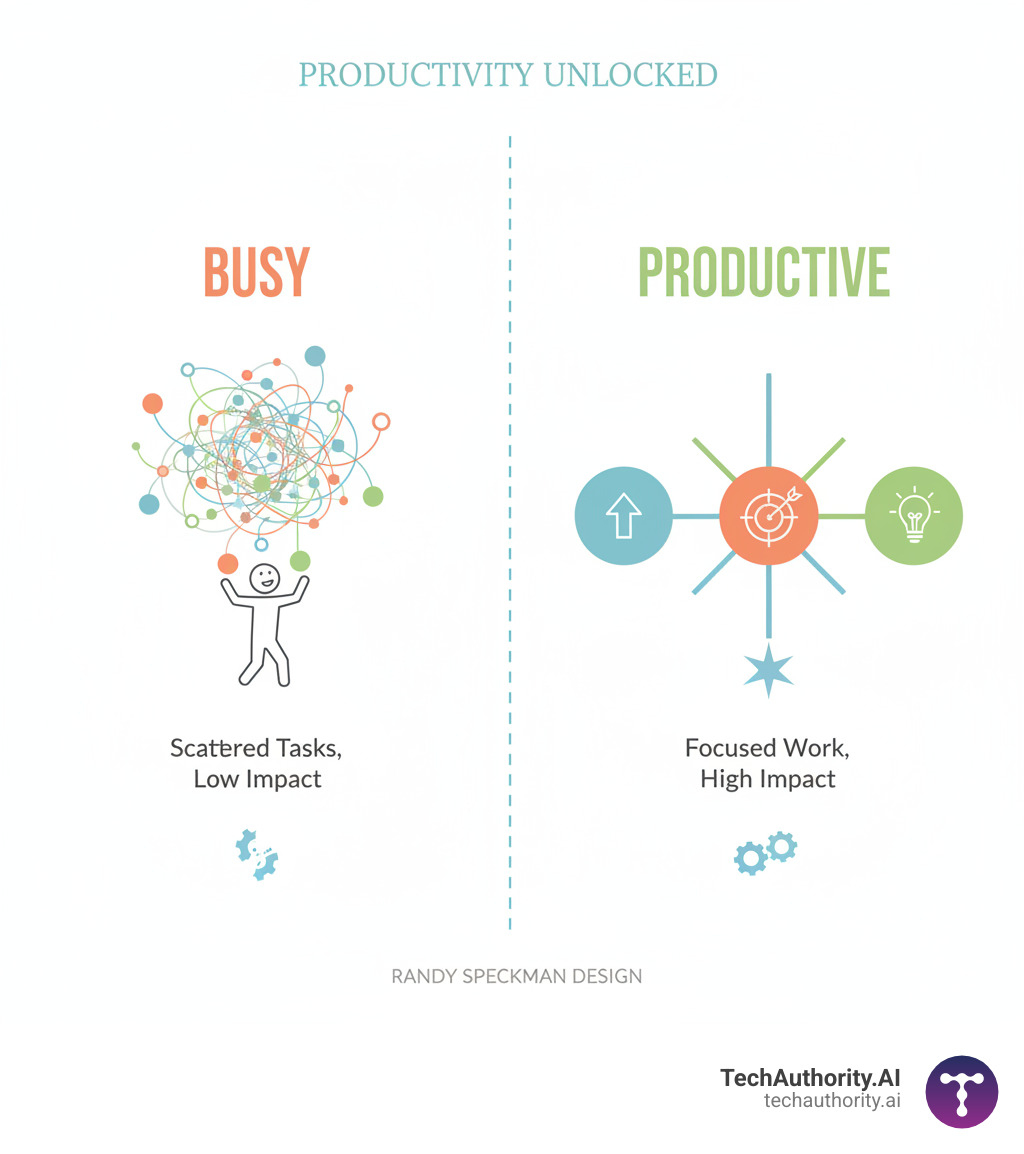
Yes, and this should be the goal. Busyness and productivity are often inversely related. Busyness signals reactive work and poor prioritization, while true productivity comes from effective, focused work on what matters. This involves proactive planning to prevent crises and setting clear boundaries to protect your energy. It also requires strategic idleness—deliberately scheduling time for rest and reflection. This isn't laziness; it's essential for creativity and preventing burnout. The result is less overwhelm, higher-quality work, and more energy for your professional and personal life.
Conclusion
The key takeaway is that true productivity isn't about frantic activity; it's about effectiveness. It's about choosing the right things to focus on and doing them well. We've seen that productivity is a blend of mindset, strategy, and tools. Understanding the human element—motivation, personality, and emotions—is as crucial as any time management technique. By using proven strategies like the Eisenhower Matrix and the Pomodoro Technique, building keystone habits, and using technology mindfully to avoid the productivity paradox, you can work smarter, not harder.
At TechAuthority.AI, we're committed to providing the resources you need to master your digital workflow. Open uping your productivity open ups your potential, creating space for innovation and growth.
Ready to take the next step? Explore our expert guides on Digital Marketing to grow your business and find more ways to work smarter. Productivity isn't about doing everything—it's about doing what matters.